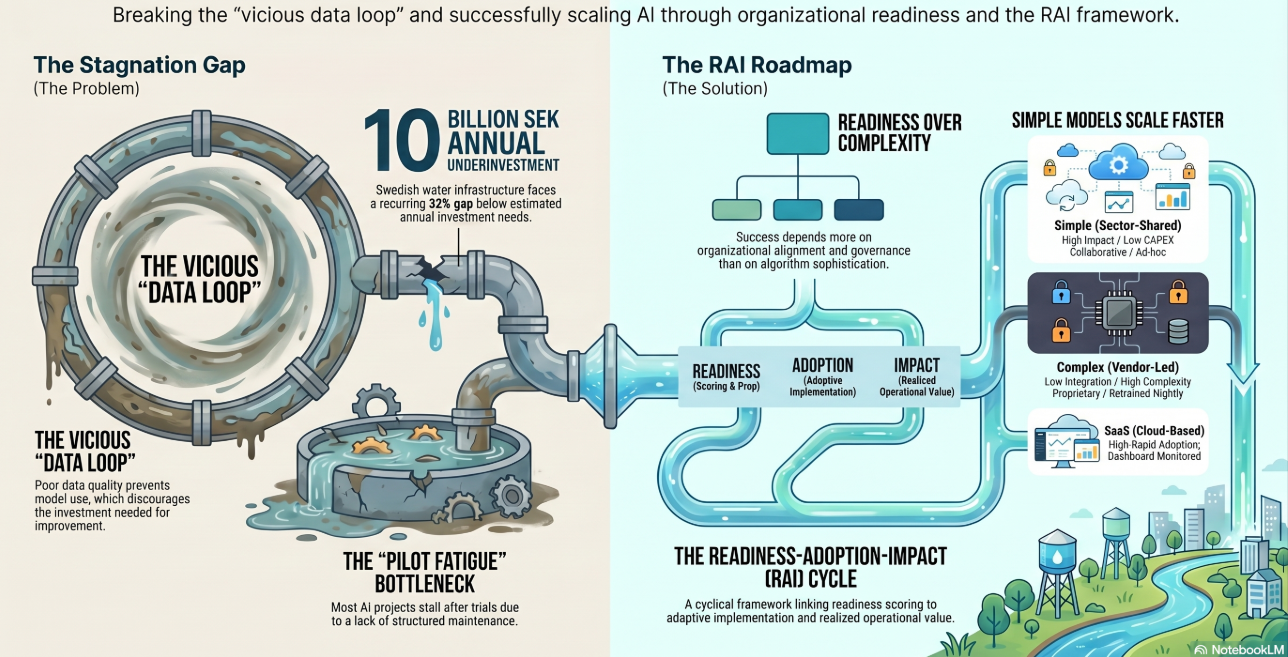
AI in Water and Wastewater – Why Is Progress So Slow?
A new article examines why the adoption of AI and machine learning is proceeding relatively slowly in the water and wastewater sector, despite the technology’s great potential.

The Mistra InfraMain project Roadmap for Scaling Up the Use and Adoption of AI and Machine Learning in Swedish Water Utilities aims to facilitate and accelerate the adoption and use of artificial intelligence and machine learning tools in Swedish water and wastewater companies. Although the technology offers many benefits, most organizations have not made significant progress in its implementation.
A new article from the project explores why the adoption of AI and machine learning in water infrastructure asset management remains slow and fragmented despite its high potential.
– We moved beyond technical discussions to investigate the sociotechnical barriers—such as organizational culture, data governance, and “pilot fatigue”—that prevent utilities from turning digital experiments into long-term operational value, says Emmanuel Okwori, project manager and one of the article’s authors.
The project has also produced an easy-to-understand fact sheet summarizing the results; you can download it here